
Advanced Lyophilization Architecture for Botanical Extraction A Comparative Engineering Analysis of TCI Scientific HiLyph and Blue Alpine Systems
This is a non-biased report showing the two builds TCI's HiLyph Freeze Dryer Vs. Blue Alpine
Lyophilization Architecture for Botanical Extraction: A Comparative Engineering Analysis of TCI Scientific HiLyph and Blue Alpine Systems
1. Executive Summary and Industry Context
The commercial stabilization of botanical biomass—specifically solventless cannabis extracts and whole-flower inflorescence—relies on the precise manipulation of thermodynamics and atmospheric pressure. Lyophilization (freeze-drying) has become the standard for preserving delicate biochemical profiles, halting oxidative degradation, and preventing the volatilization of monoterpenes and sesquiterpenes.[1, 1]
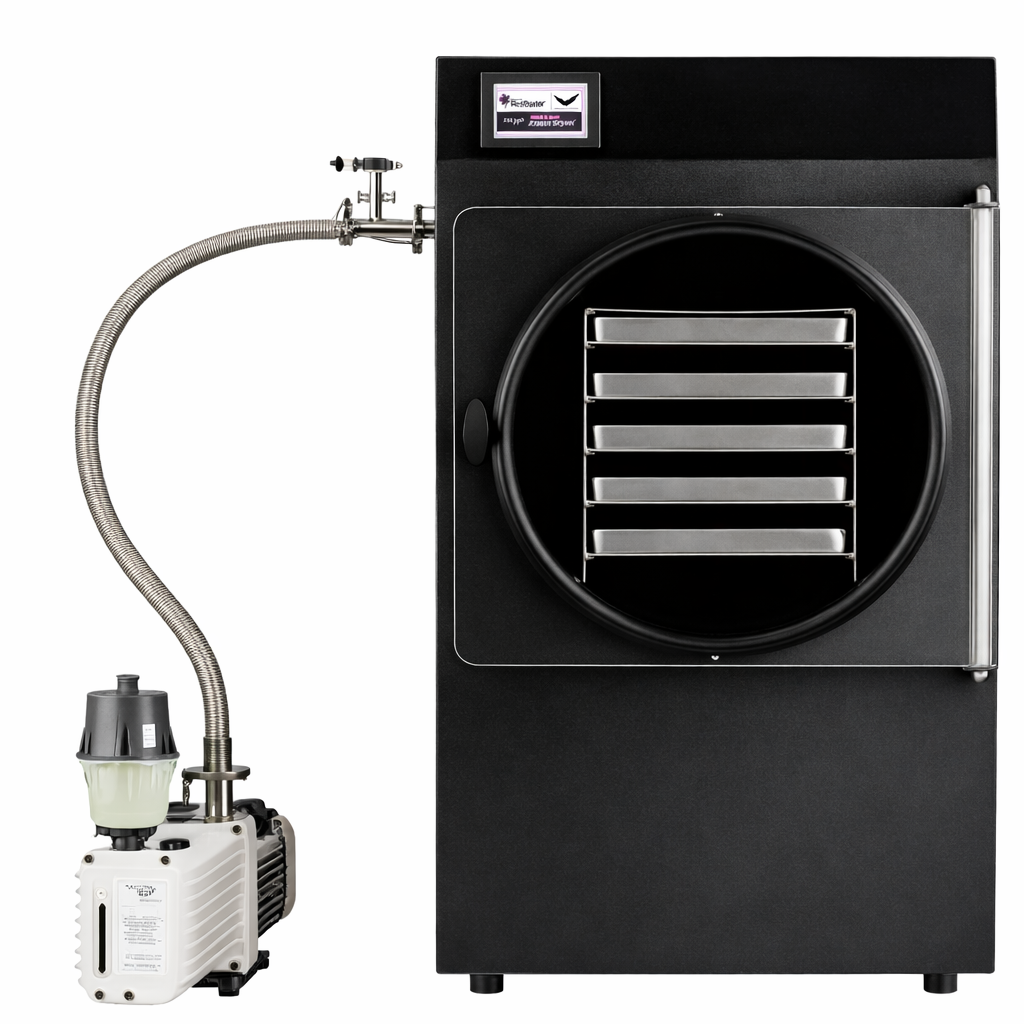
As the market has matured, equipment manufacturers have diverged in their engineering philosophies. Two distinct platforms currently serve the prosumer and commercial laboratory sectors: the Blue Alpine Freeze Dryers and the HiLyph Table Top Freeze Dryers (manufactured by TCI Scientific Innovations, LLC).1
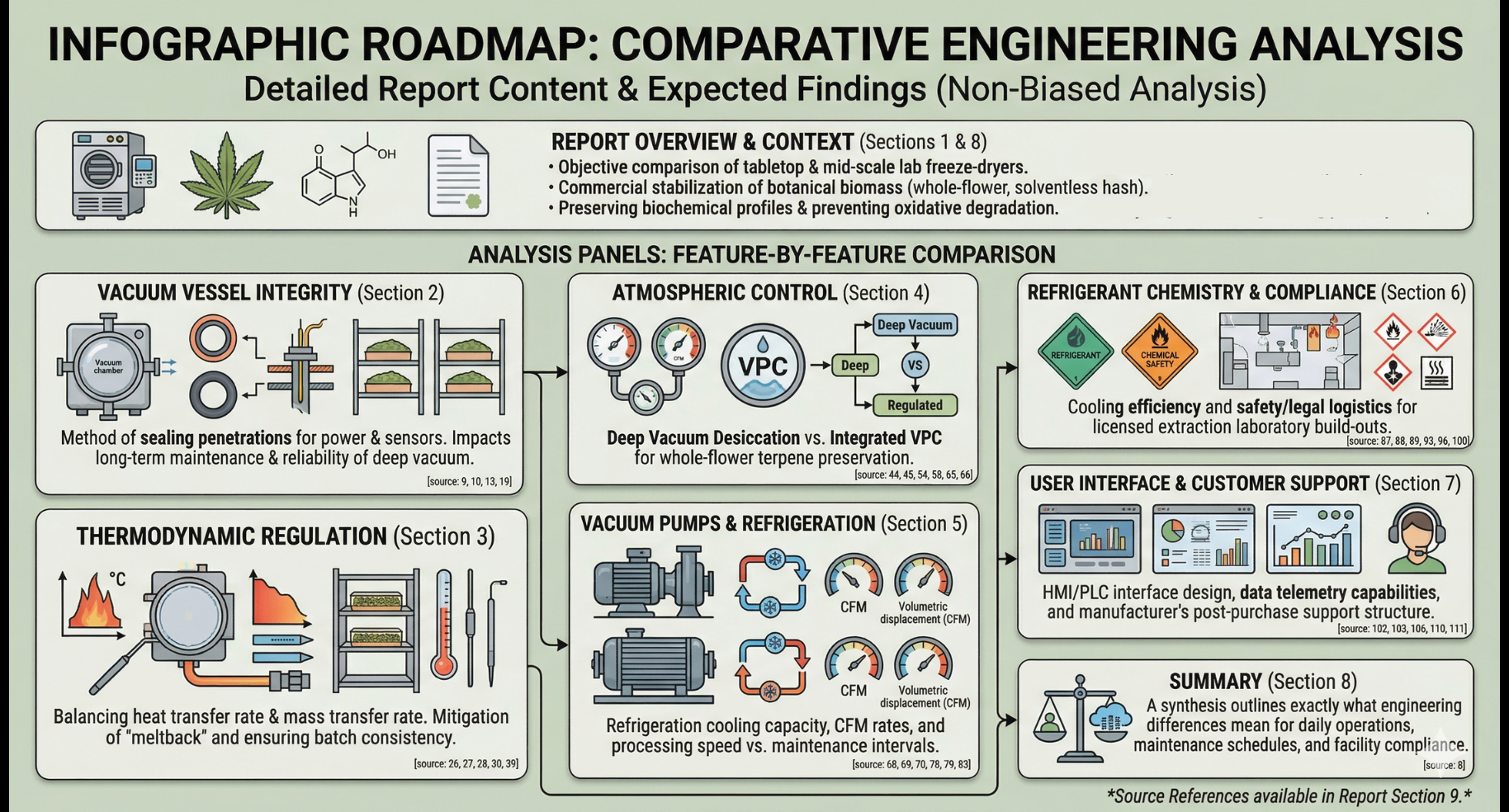
This report provides an objective, feature-by-feature comparison of the tabletop and mid-scale laboratory units from both brands (excluding the industrial-scale Cuddon-manufactured HiLyph units). This analysis examines vacuum vessel integrity, thermodynamic regulation, atmospheric manipulation, pump integration, and refrigerant selection to outline what each platform offers and how those engineering differences affect the consumer's daily operations, maintenance schedules, and facility compliance.
2. Vacuum Vessel Integrity and Electrical Feed-Throughs
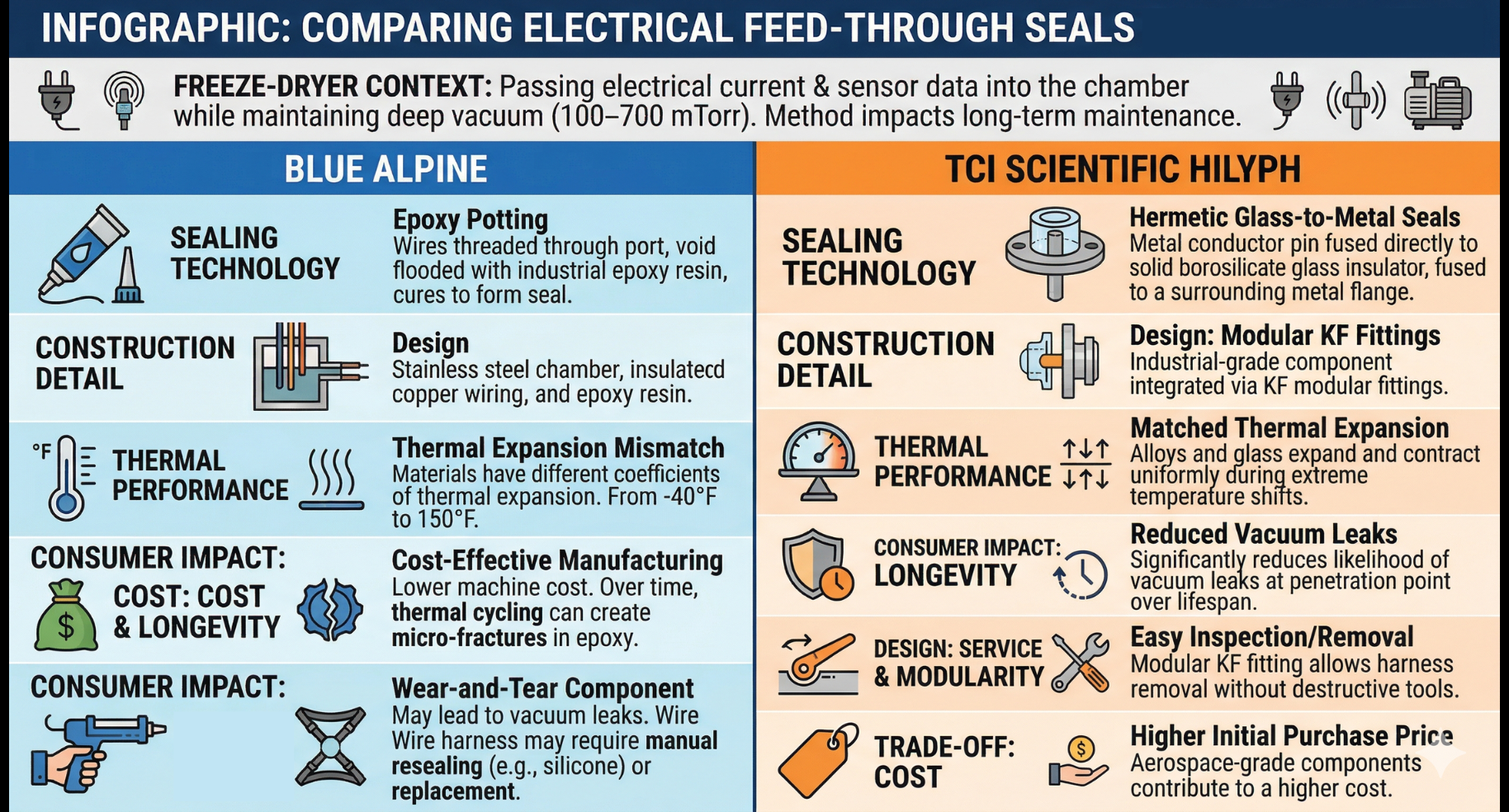
A freeze-dryer must pass electrical current and sensor data through the solid wall of the vacuum chamber to the internal product shelves while maintaining a vacuum (typically between 100 and 700 mTorr).[1, 1, 1] The method used to seal this penetration impacts the machine's long-term maintenance requirements.
2.1 Blue Alpine: Epoxy Potting
Blue Alpine utilizes a manufacturing technique known as "epoxy potting" for its electrical wire harnesses.1 In this design, the insulated copper wires are threaded through a machined port, and the remaining void is flooded with an industrial epoxy resin that cures to form a vacuum seal.1
●
Consumer Impact:
Epoxy potting is cost-effective, which helps keep the overall manufacturing and retail cost of the machine lower. However, because the stainless-steel chamber, copper wiring, and epoxy resin have different coefficients of thermal expansion,
the temperature shifts of freeze-drying (from to ) cause these materials to expand and contract at different rates.[1, 1, 1] Over time, this thermal cycling can create micro-fractures in the epoxy, leading to vacuum leaks.1 For the consumer, this means the wire harness is a wear-and-tear component that may require manual resealing with silicone or complete replacement if vacuum errors occur.3
2.2 TCI Scientific HiLyph: Hermetic Glass-to-Metal Seals
The TCI Scientific HiLyph series utilizes hermetic glass-to-metal seals integrated via KF (Klein Flange) modular vacuum fittings.[1, 1, 21] The metal conductor pin is fused directly to a solid borosilicate glass insulator, which is fused to a surrounding metal flange.1
●
Consumer Impact:
The alloys and glass used in this seal share matched coefficients of thermal expansion, allowing them to expand and contract uniformly during temperature shifts.1 For the consumer, this industrial-grade component reduces the likelihood of vacuum leaks developing at the penetration point over the lifespan of the machine.1 Additionally, the modular KF fitting allows the harness to be easily inspected or removed without destructive tools.1 The trade-off is that these components contribute to a higher initial purchase price for the machine.
3. Thermodynamic Regulation and Shelf Heating
Balancing the heat transfer rate (energy entering the biomass) with the mass transfer rate (water vapor leaving the biomass) is critical. If the product is heated too quickly, it can breach its collapse temperature, leading to "meltback"—a phase where the ice melts into liquid water and boils under vacuum, degrading the product's structure and terpenes.1
3.1 Blue Alpine: Single-Zone Heating
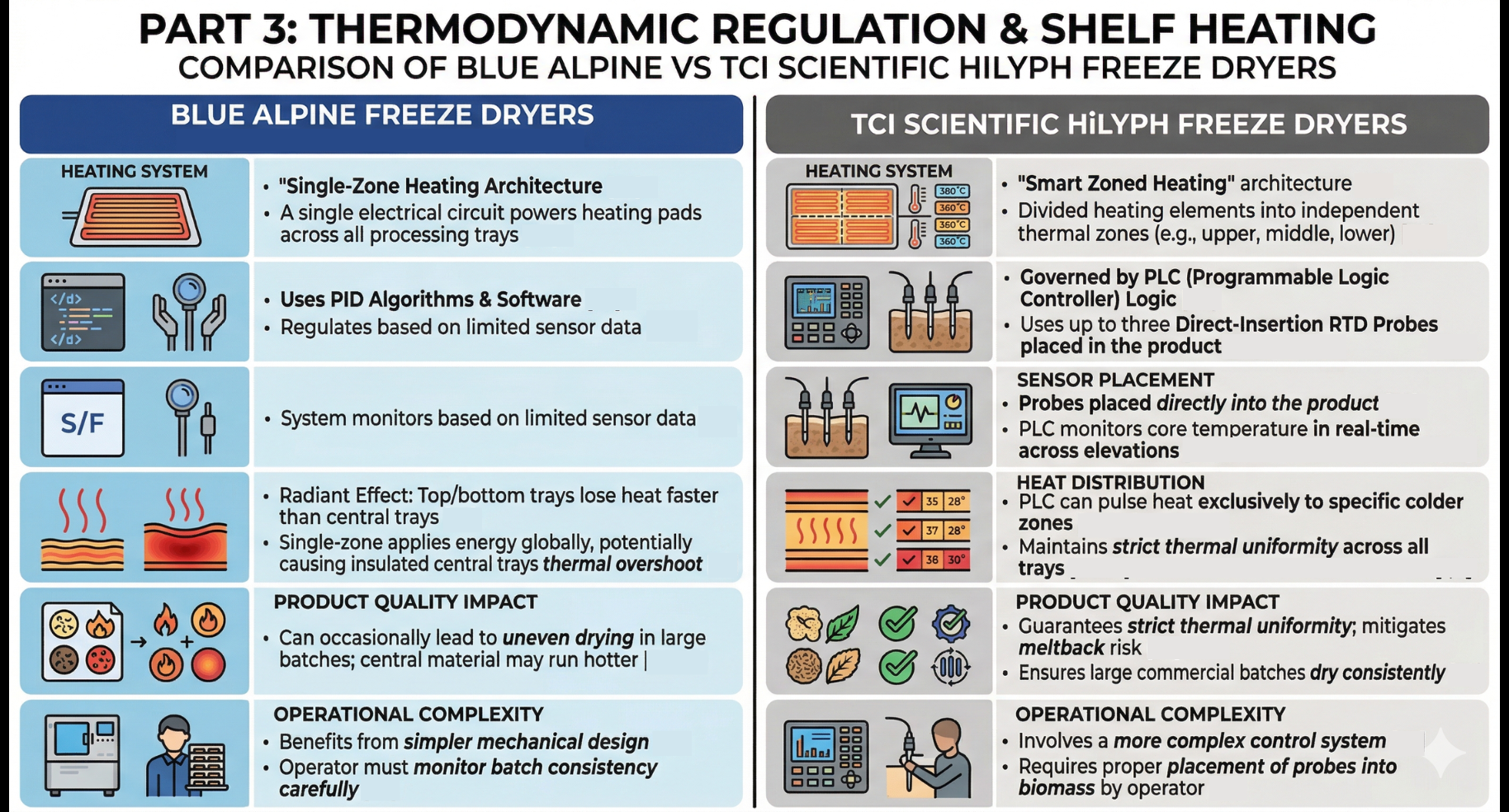
Blue Alpine employs a single-zone heating architecture.1 A single electrical circuit powers the heating pads across all processing trays, and the system regulates temperature using PID (Proportional-Integral-Derivative) software algorithms based on limited sensor data.1
●
Consumer Impact:
In a vacuum, top and bottom trays lose heat to the cold chamber walls faster than central trays (the radiant effect).1 When a single-zone system attempts to heat the outer trays, it applies energy globally, which can cause the insulated central trays to experience thermal overshoot.1 For the consumer, this can occasionally lead to uneven drying across a batch; material in the center may run hotter than material on the top or bottom.1 The consumer benefits from a simpler mechanical design, but must monitor batch consistency carefully when processing dense loads.
3.2 TCI Scientific HiLyph: Multi-Zone Heating and RTD Probes
The HiLyph Large and XL models utilize a "Smart Zoned Heating" architecture, dividing the heating elements into independent thermal zones (e.g., upper, middle, lower).1 Temperature regulation is governed by up to three direct-insertion Resistance Temperature Detectors (RTD probes) placed directly into the product.[1, 1]
●
Consumer Impact:
The system's Programmable Logic Controller (PLC) monitors the core temperature of the product in real-time across different elevations.[1, 1] If the top shelf cools faster than the middle, the PLC can pulse heat exclusively to the upper zone.1 For the consumer, this ensures thermal uniformity across all trays, mitigating the risk of meltback and ensuring that commercial batches dry consistently.1 The trade-off is a more complex control system that requires the operator to properly place the physical probes into the biomass before starting a cycle.
3.3 Active Airflow: Expedited Fan Cooling and Defrosting
The efficiency of a commercial lyophilizer is dictated not only by its primary drying speed but also by the time required to initially freeze the product and the turnaround time required to defrost the ice trap between batches.
●
TCI Scientific HiLyph (Large and XL Models):
To increase operational throughput, the HiLyph Large and XL models are engineered with expedited fan cooling directly on the shelving units.1 This active airflow accelerates the initial freezing phase, ensuring the biomass reaches vitrification temperatures faster.1 Additionally, these specific models feature a fan-assisted "Fast Defrost Mode".1
○
Consumer Impact:
For the commercial operator, expedited fan cooling protects the cold chain by freezing the product rapidly, while the fan-assisted defrost reduces the downtime between cycles, allowing facilities to process more batches per week.1
●
Blue Alpine:
Blue Alpine systems do not have fan-assisted cooling or defrosting.
○
Consumer Impact:
Without active fan assistance, the system relies entirely on passive thermal transfer to freeze the product and melt the ice trap. For the consumer, this extends both the initial freezing phase and the turnaround time between cycles, as operators must wait longer for the ice accumulation on the condenser coils to melt before loading the next batch.
4. Atmospheric Control Capabilities: Deep Vacuum vs. Integrated VPC
The internal atmospheric pressure dictates the speed of sublimation and the retention of volatile compounds. To accurately compare the two brands, this analysis divides their capabilities into two distinct operational categories: Non-VPC Operation and VPC Operation.
4.1 Non-VPC Operation (Deep Vacuum Desiccation)
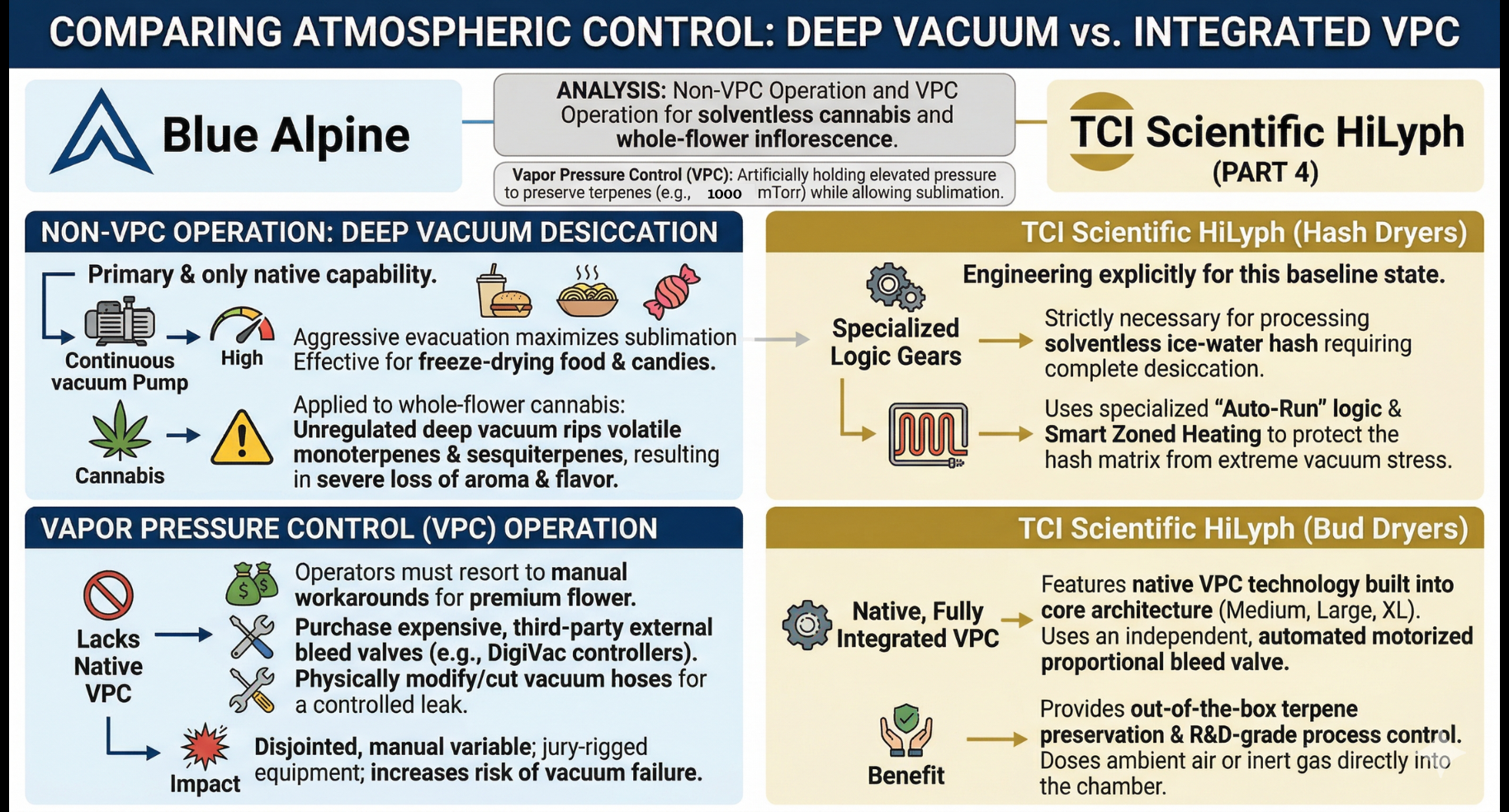
In a standard Non-VPC cycle, the vacuum pump engages and continuously pulls the internal chamber pressure down to the lowest achievable limit, frequently dropping below 100 mTorr.1 Both Blue Alpine and TCI Scientific HiLyph are capable of operating in this baseline mode.
●
Blue Alpine:
Operating in a deep-vacuum state is the primary and only native capability of Blue Alpine systems.1 This continuous evacuation maximizes the speed of water sublimation, which is effective for freeze-drying foods and candies.1 However, when
applied to whole-flower cannabis, the unregulated deep vacuum draws volatile monoterpenes out of the plant alongside the water vapor, resulting in a loss of aroma and flavor.1
●
TCI Scientific HiLyph (Hash Dryers):
The HiLyph Hash Dryer models are explicitly engineered to operate in this baseline deep-vacuum state, as it is necessary for processing solventless ice-water hash where complete desiccation is required.1 To protect the hash matrix from the stress of deep vacuum, the HiLyph utilizes specialized "Auto-Run" logic and Smart Zoned Heating to balance localized thermal input against the vacuum pull, ensuring the hash does not degrade.1
4.2 Vapor Pressure Control (VPC) Operation
To preserve terpenes in whole-flower cannabis, the atmospheric pressure must be artificially held at a calibrated, elevated setpoint (typically 400 to 700 mTorr).1 This establishes a thermodynamic vapor barrier that suppresses terpene volatilization while still allowing water molecules to sublimate.1
Blue Alpine does not have a VPC machine.
Because Blue Alpine systems lack native Vapor Pressure Control, operators attempting to process flower often use manual workarounds.1 This involves purchasing third-party external bleed valves (such as DigiVac controllers) and modifying the freeze-dryer's vacuum hoses to introduce a controlled leak.1 This introduces a manual variable into the process, increasing the risk of vacuum failure and resulting in a modified equipment setup.1
●
TCI Scientific HiLyph (Integrated VPC):
The TCI Scientific HiLyph Bud Dryer models (Medium, Large, and XL) feature native, fully integrated VPC technology built directly into the system's core architecture.1 The HiLyph utilizes an independent, automated motorized proportional bleed valve that intelligently doses ambient air or inert gas directly into the chamber to maintain the exact pressure setpoint.1 For the consumer, this purpose-built approach provides integrated terpene preservation and process control, eliminating the need for external modifications or third-party controllers.1
5. Vacuum Pumps and Refrigeration Capacities
The interaction between the condenser coils and the vacuum pump determines how efficiently the machine handles the volume of water vapor generated by wet biomass.
5.1 Blue Alpine: High-Capacity Cooling and Standard Pumps
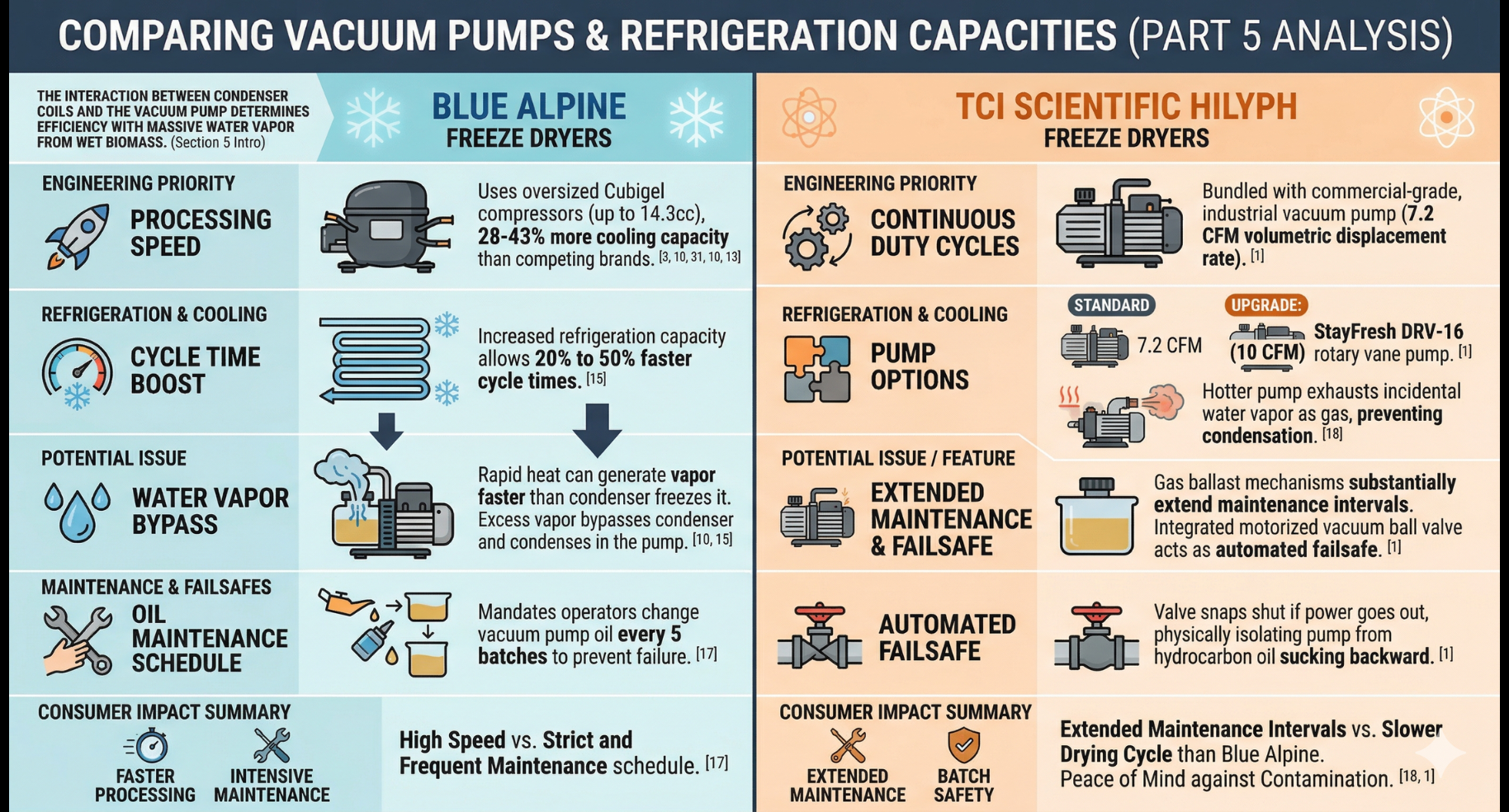
Blue Alpine prioritizes processing speed. Their systems are built with larger Cubigel compressors (featuring up to 14.3cc displacement), providing higher cooling capacity than competing brands.[3, 10, 31, 10, 13]
●
Consumer Impact (Speed vs. Maintenance):
The increased refrigeration capacity allows Blue Alpine machines to achieve cycle times that are 20% to 50% faster than competitors.15 However, applying heat rapidly to achieve these speeds can sometimes generate water vapor faster than the condenser can freeze it. When excess vapor bypasses the condenser, it enters the vacuum pump and condenses into liquid water, degrading the pump oil.17 Consequently, Blue Alpine officially mandates that operators change the vacuum pump oil every 5 batches to prevent pump failure.19 For the consumer, the trade-off is clear: faster processing times in exchange for a high-frequency oil maintenance schedule.
5.2 TCI Scientific HiLyph: Industrial Pumps and Isolation Valves
TCI Scientific prioritizes continuous duty cycles. All HiLyph units are bundled with a commercial-grade, industrial vacuum pump boasting a volumetric displacement rate of 7.2 CFM.1 As an upgrade available across all machine sizes (Medium, Large, and XL), operators can opt for the DRV-16, a 10 CFM industrial rotary vane pump.1 Additionally, the HiLyph utilizes an integrated motorized vacuum ball valve between the pump and the chamber.[1, 1]
●
Consumer Impact (Durability vs. Cycle Time):
The industrial pumps feature specific gas ballast mechanisms that run hotter, exhausting incidental water vapor as a gas rather than condensing it into the oil reservoir, which extends the maintenance interval between oil changes.1 Furthermore, the motorized ball valve acts as an automated failsafe; if the power goes out, the valve snaps shut, physically isolating the pump and preventing hydrocarbon oil from drawing backward into the product chamber (oil backstreaming).[1, 1] For the consumer, this provides extended maintenance intervals and protection against batch contamination, though the overall drying cycle may take longer than a Blue Alpine machine.
6. Refrigerant Chemistry and Facility Compliance
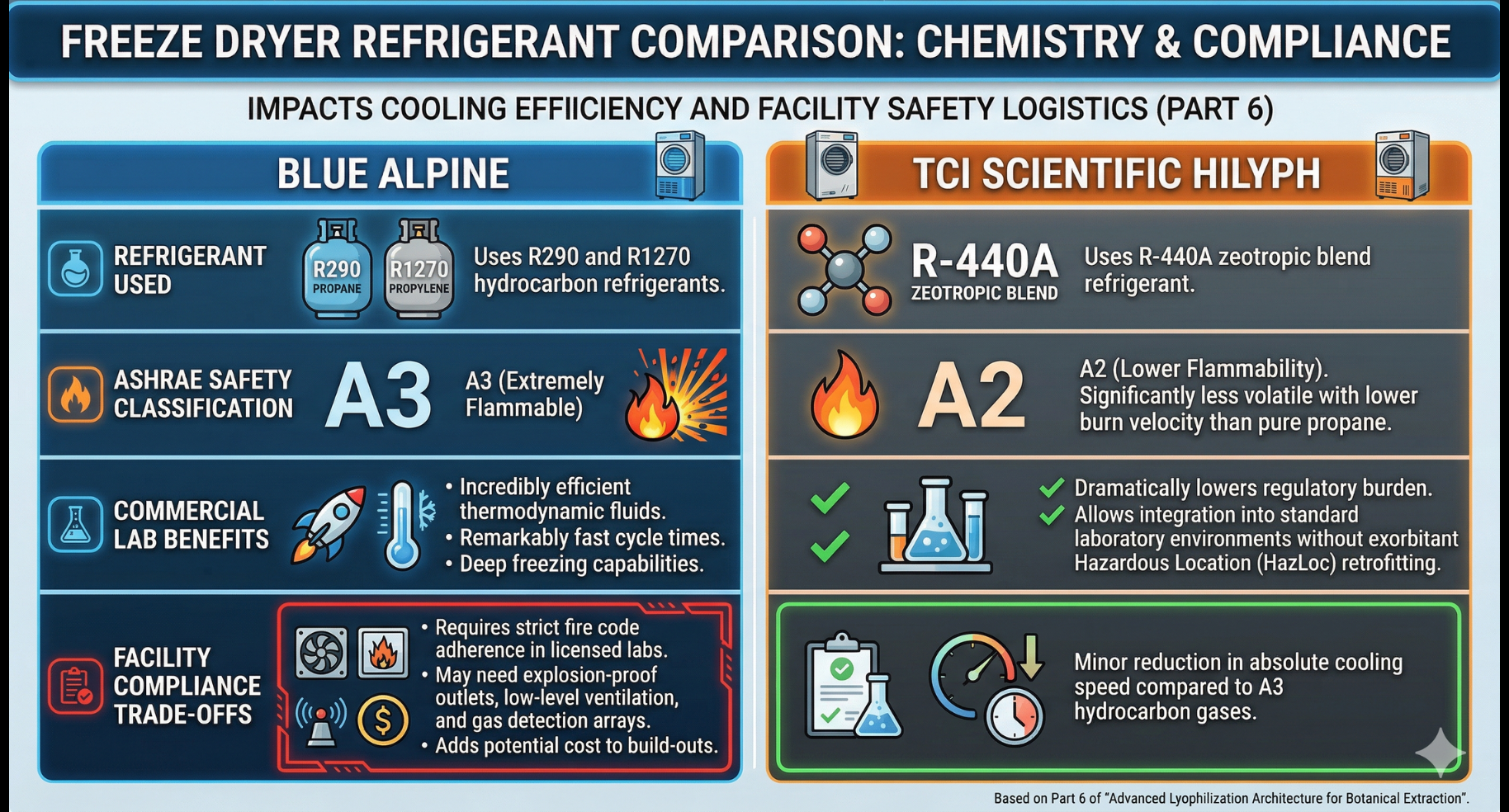
The chemical refrigerant utilized impacts both cooling efficiency and the legal/safety logistics of housing the equipment in a commercial extraction laboratory.1
6.1 Blue Alpine: R290 and R1270 (A3 Classification)
Blue Alpine utilizes
R290
(purified propane) and
R1270
(propylene) refrigerants. 13
●
Consumer Impact:
These hydrocarbon refrigerants are efficient thermodynamic fluids, which directly contribute to Blue Alpine's faster cycle times and deep freezing capabilities.13 However, both carry an ASHRAE safety classification of
A3 (Extremely Flammable).1 For the consumer—particularly commercial facility directors—introducing an A3 appliance into a licensed, enclosed laboratory requires strict adherence to local fire codes. It may necessitate the installation of explosion-proof electrical outlets, low-level ventilation, or gas detection arrays, adding cost to facility build-outs.26
6.2 TCI Scientific HiLyph: R-440A (A2 Classification)
TCI Scientific tabletop models utilize
R-440A, a specialized zeotropic blend refrigerant.1
●
Consumer Impact:
R-440A carries an ASHRAE classification of
A2 (Lower Flammability).1 While still technically flammable, it is less volatile and has a lower burn velocity than pure propane.1 For the commercial consumer, this A2 classification lowers the regulatory burden, allowing the machine to be integrated into standard laboratory environments without requiring Hazardous Location (HazLoc) retrofitting.1 The trade-off is a minor reduction in absolute cooling speed compared to A3 hydrocarbon gases.
7. User Interface and Customer Support
The daily operational experience is heavily influenced by the machine's software interface and the manufacturer's post-purchase support structure.
7.1 Blue Alpine: Consumer Experience
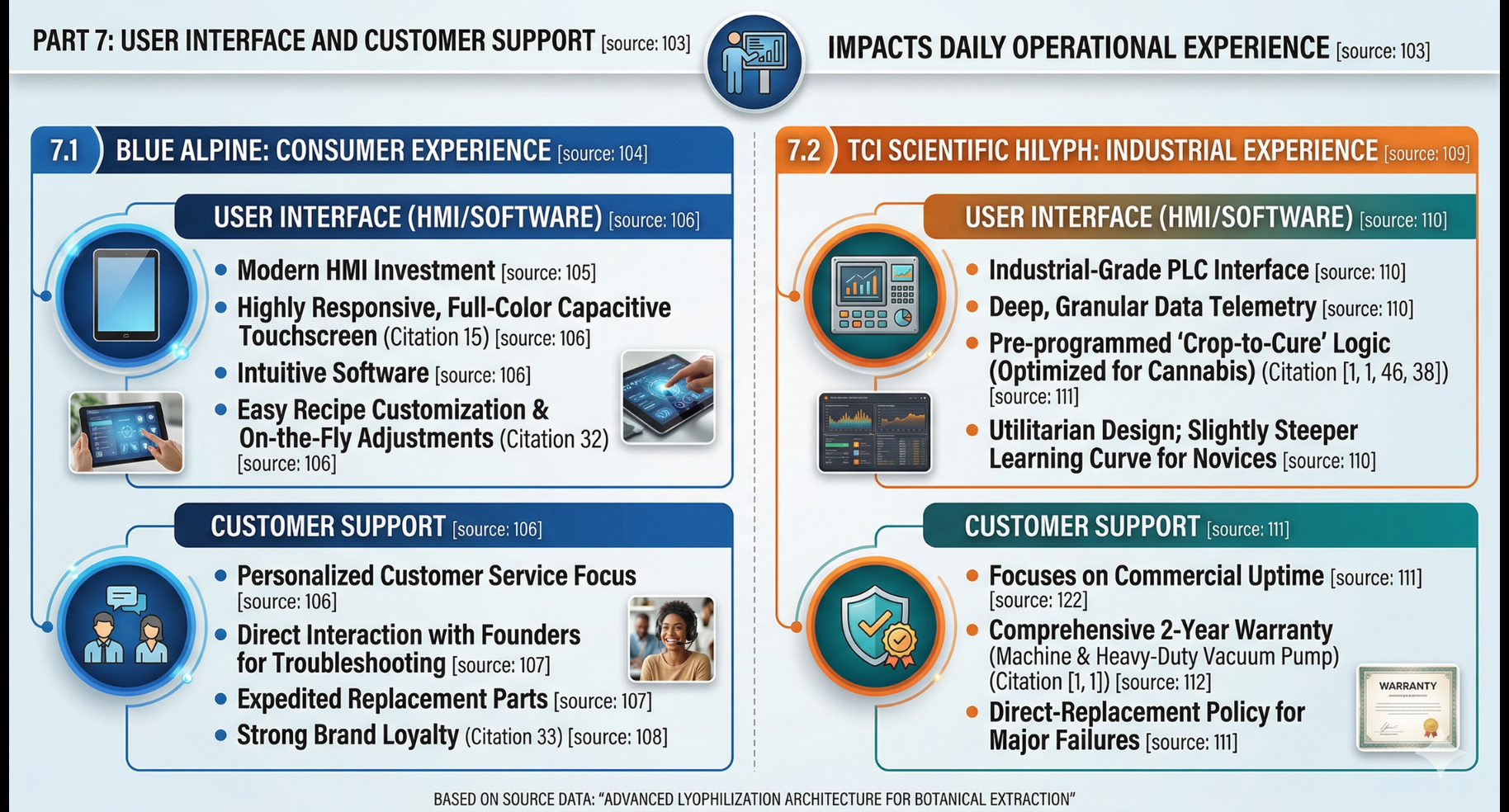
Blue Alpine has invested in a modern Human-Machine Interface (HMI). Their systems feature a responsive, full-color capacitive touchscreen.15 The software is intuitive, allowing users to easily customize recipes and adjust active batches on the fly.32 Furthermore, Blue Alpine has built a reputation for personalized customer service. The founders frequently interact directly with users to troubleshoot issues and expedite replacement parts, creating brand loyalty among their consumer base.33
7.2 TCI Scientific HiLyph: Industrial Experience
The HiLyph platform utilizes an industrial-grade PLC interface. While it offers detailed data telemetry and pre-programmed "Crop-to-Cure" logic optimized explicitly for cannabis, the interface is utilitarian and presents a slightly steeper learning curve for absolute novices compared to Blue Alpine's smartphone-style screen.[1, 1, 46, 38] From a support standpoint, TCI Scientific focuses on commercial uptime by offering a comprehensive two-year warranty that explicitly covers both the machine and the vacuum pump via a direct-replacement policy for major failures.[1, 1]
8. Summary
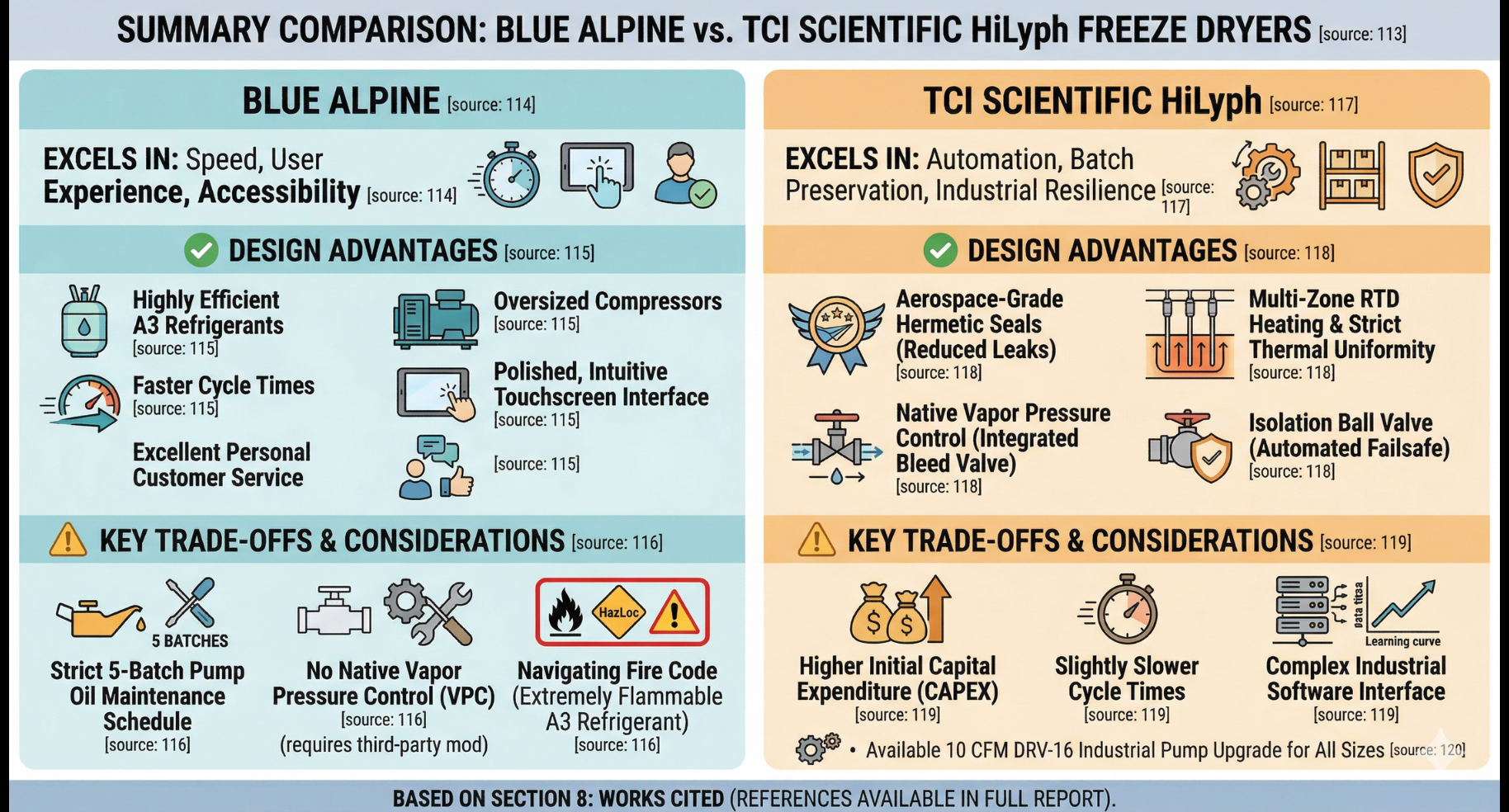
● Blue Alpine focuses on speed, user experience, and accessibility. By utilizing efficient A3 refrigerants and larger compressors, they offer faster cycle times and an intuitive touchscreen interface backed by personal customer service. The trade-offs for the consumer involve a strict 5-batch pump oil maintenance schedule, the lack of native vapor pressure control without third-party hardware modifications, a lack of fan-assisted cooling or defrosting, and the requirement to navigate the fire code implications of a flammable refrigerant.
● TCI Scientific HiLyph
focuses on automation, batch preservation, and industrial resilience. By integrating hermetic seals, multi-zone RTD heating, expedited fan cooling, native Vapor Pressure Control, and an isolation ball valve, the system is designed to run consistently in a commercial lab without manual intervention or third-party add-ons. The trade-offs for the consumer include a higher initial capital expenditure, slightly slower cycle times, and a more complex industrial software interface. The 10 CFM DRV-16 industrial pump upgrade is available to maximize capability across all sizes.
- Works cited
- Comparative Analysis of Lyophilization Technologies for Solventless Extraction_ Holland Green Science Xiros Mikro versus TCI Scientific HiLyph Hash Dryer Series.docx
- Best Freeze Dryer for Engineers: Why Stay Fresh Leads the Pack - No Ordinary Homestead, accessed March 27, 2026, https://www.noordinaryhomestead.com/best-freeze-dryer-for-engineers-why-st ay-fresh-leads-the-pack/
- Freeze Dryer Replacement Parts - Electronics, Filters, and More! – Page 3 – Blue Alpine, accessed March 27, 2026, https://bluealpinefreezedryers.com/collections/freeze-dryer-replacement-parts? page=3
- S90035-00 Medium Wire Pass Through Sub-Assembly - Blue Alpine Freeze Dryers, accessed March 27, 2026, https://bluealpinefreezedryers.com/products/medium-wire-pass-through-sub-as sembly
- Epoxy Feedthroughs - Douglas Electrical Components, accessed March 27, 2026, https://douglaselectrical.com/epoxy-feedthroughs/
- Chamber Pressure Not Achieving Vacuum - Support, accessed March 27, 2026, https://support.bluealpinefreezedryers.com/forum/technical-support-forum-1/ch amber-pressure-not-achieving-vacuum-11
- Glass-to-Metal Vs. Epoxy Hermetic Seals - Douglas Electrical Components, accessed March 27, 2026, https://tech.douglaselectrical.com/hubfs/Hermetic%20Seal%20Types-GTM%20v s%20Epoxy.pdf?hsLang=en
- Large Freeze Dryer - For Food and More (Pre-Order Sale) – Blue Alpine, accessed March 27, 2026, https://bluealpinefreezedryers.com/products/rev-3-large-freeze-dryer
- Several Common Defects Of Freeze-dried Products And Solutions - LABOAO, accessed March 27, 2026, https://www.lfreezedryer.com/news/several-common-defects-of-freeze-dried-pr oducts-and-solutions
- What Are Some Common Problems To Avoid During Freeze Drying? Prevent Melt-Back And System Overload - Kintek Solution, accessed March 27, 2026, https://kindle-tech.com/faqs/what-are-some-common-problems-to-avoid-durin g-freeze-drying
11. ALPINETM - F.W. Webb, accessed March 27, 2026, https://fwwebbimage.fwwebb.com/ProductInfo/Alpine_I-O.pdf
12. PUREFIRE REV 2 - Alpine Home Air, accessed March 27, 2026, https://documents.alpinehomeair.com/product/IOM_purefire_REV2_web.pdf
- Large Freeze Dryer - For Candy, Food and More (Pre-Order Sale) – Blue Alpine, accessed March 27, 2026, https://bluealpinefreezedryers.com/products/large-freeze-dryer
- Freeze Dryer Heat Racks - Medium, Customized | Blue Alpine, accessed March 27, 2026,
- https://bluealpinefreezedryers.com/products/freeze-dryer-heat-rack-medium
15. Freeze Dryer Comparison - Blue Alpine Review, accessed March 27, 2026, https://bluealpinefreezedryers.com/pages/freeze-dryer-comparison
16. Medium Freeze Dryer - For Candy, Food and More – Blue Alpine, accessed March 27, 2026,
https://bluealpinefreezedryers.com/products/medium-freeze-dryer-copy
17. Excessive Water in the Pump - Support, accessed March 27, 2026, https://support.bluealpinefreezedryers.com/forum/technical-support-forum-1/ex cessive-water-in-the-pump-15
18. Freeze Dryer Vacuum Pump Maintenance and Troubleshooting - Millrock Technology, accessed March 27, 2026, https://www.millrocktech.com/tech-note-vacuum-pump-maintenance-and-troub leshooting-2/
19. Harvest Right vs Blue Alpine, accessed March 27, 2026, https://harvestright.com/pages/harvest-right-vs-alpine
20. Harvest Right vs Blue Alpine: The Ultimate Freeze Dryer Comparison - Trimleaf, accessed March 27, 2026, https://trimleaf.com/pages/harvest-right-vs-blue-alpine-freeze-dryer
21. Buy Freeze Dryer | Blue Alpine - Growcycle, accessed March 27, 2026, https://growcycle.com/growers/harvest/freeze-dryers/freeze-dryer-blue-alpine
- Compressor/Condenser - NPT16LR - R290, Large - Blue Alpine Freeze Dryers, accessed March 27, 2026, https://bluealpinefreezedryers.com/products/compressor-condenser-npt16lr-larg e
- Refrigerant Comparison: R290 vs. R404a | Diversified CPC, accessed March 27, 2026, https://diversifiedcpc.com/r290-vs-r404a
24. R-290 Safety Data Sheet - National Refrigerants, Inc., accessed March 27, 2026, https://refrigerants.com/wp-content/uploads/2019/12/SDS-R290-Propane.pdf
25. R290 Refrigerant: A Potential Explosion RiskContent - SolarEast, accessed March 27, 2026,
https://www.solareasthvac.com/r290-refrigerant-a-potential-explosion-riskconte
nt.html
26. Refrigeration - Kansas State University, accessed March 27, 2026, https://www.k-state.edu/safety/programs/lab/chemical/refrigeration.html
- Appendix R to Subpart G of Part 82, Title 40 -- Substitutes Subject to Use Restrictions Listed in the December 20, 2011, Final Rule, Effective February 21, 2012, in the April 10, 2015, Final Rule, Effective May 11, 2015, in the April 28, 2023, Final Rule, Effective May 30, 2023, and in the June 13, 2024, Final Rule, Effective July 15, 2024 - eCFR, accessed March 27, 2026, https://www.ecfr.gov/current/title-40/chapter-I/subchapter-C/part-82/subpart-G/ appendix-Appendix%20R%20to%20Subpart%20G%20of%20Part%2082
- UNIVERSITY OF OREGON CAMPUS DESIGN STANDARDS APPENDIX - LABORATORIES 12/2025 Appendix, accessed March 27, 2026, https://cpfm.uoregon.edu/laboratory-appendix
29. TCI Scientific Innovations: HiLyph Freeze Dryers, accessed March 27, 2026, https://www.tciscientific.com/
- Risk Mitigation with use of R-1150 (Ethylene) in VLTR (Freeze Dryers) - Regulations.gov, accessed March 27, 2026, https://downloads.regulations.gov/EPA-HQ-OAR-2021-0836-0033/attachment_7. pdf
- Stay Fresh vs. Blue Alpine Freeze Dryers: Which is Best? - OffGrid Living, accessed March 27, 2026, https://www.offgridlivingsolutions.com/blogs/news/stay-fresh-vs-blue-alpine-fre eze-dryers-comparison
- Blue Alpine Freeze Dryer Review: Way Easier than Harvest Right (My Honest Experience), accessed March 27, 2026, https://www.youtube.com/watch?v=ckMoOwVVnBw
- Hello!! Looking for opinions and honest reviews of the Blue Alpine freeze dryer...currently own a medium Harvest Right, constant issues and looking to make a possible change. TIA! : r/FreezeDrying - Reddit, accessed March 27, 2026, https://www.reddit.com/r/FreezeDrying/comments/1g3w8ct/hello_looking_for_opi nions_and_honest_reviews_of/
- Harvest right vs Stay fresh vs Blue Alpine : r/FreezeDrying - Reddit, accessed March 27, 2026, https://www.reddit.com/r/FreezeDrying/comments/1bx0l6c/harvest_right_vs_stay _fresh_vs_blue_alpine/
35. Blue Alpine | Reviews on Judge.me, accessed March 27, 2026, https://judge.me/reviews/stores/bluealpinefreezedryers.com
Ready to work with TCI Scientific Innovations?
Let's connect! We’re here to help.
Send us a message and we’ll be in touch.
Or give us a call today at 18774379379
Agency Contact Form
More Marketing Tips, Tricks & Tools
TCI Scientific Innovations, LLC's Blog